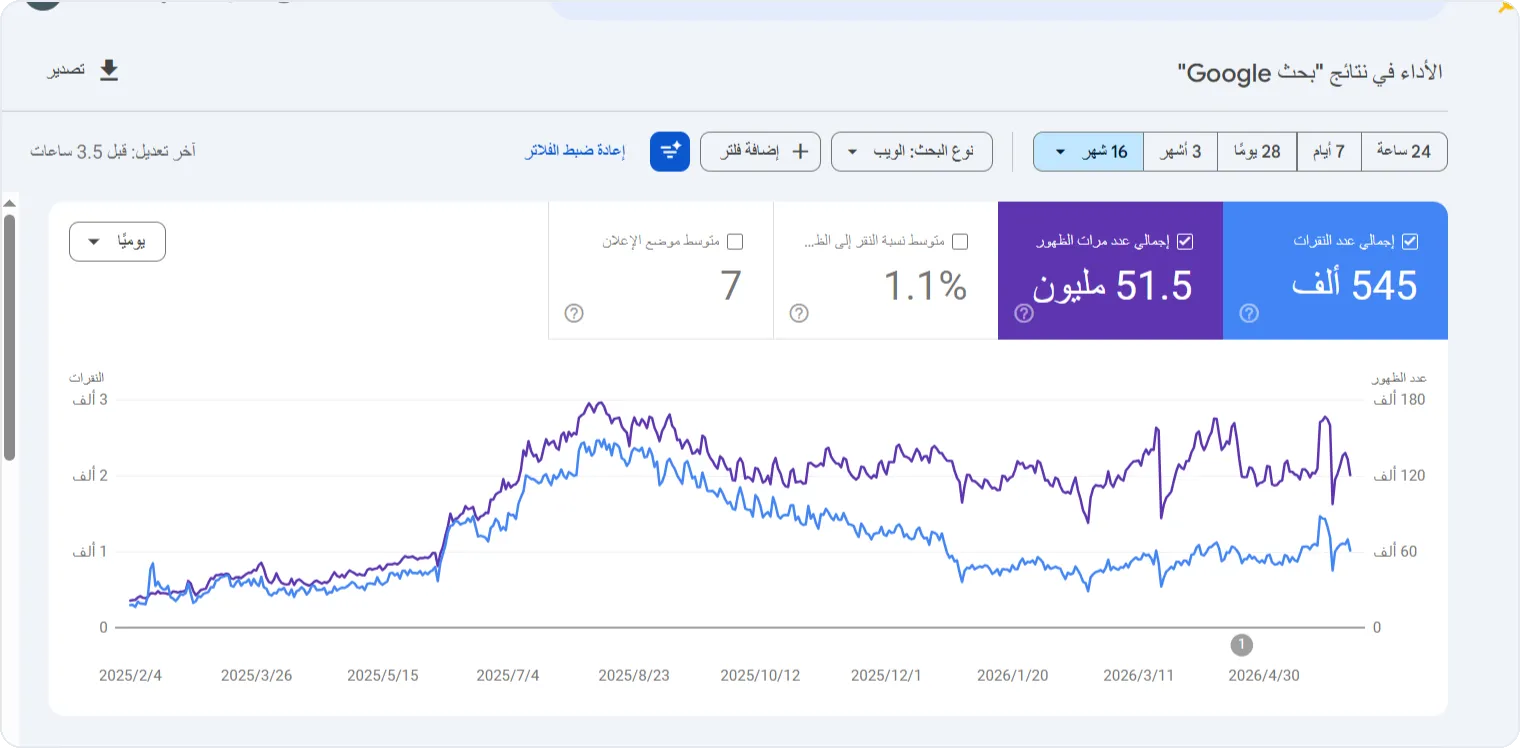
From ~25 impressions/day to 51.5M impressions in 16 months — a 17-point technical fix, on-page rebuild and 100+ articles.
Real screenshots from the tools
Actual data from the client account — nothing dressed up.
The starting point: a store Google could barely see
Picture owning an ambitious beauty brand in the Saudi market — real products, satisfied customers, a polished store on Salla — and then opening Google Search Console to find a number that reads almost like an insult: roughly 25 impressions a day. Not 25 clicks; 25 impressions. In practical terms, the store did not exist in the search results where Saudis decide where to buy their skincare, their fragrance, their beauty. It was invisible at the exact moment of intent.
That was the emotional and commercial reality of Roseberry KSA. The market around it is anything but quiet. Specialist players — established Saudi beauty marketplaces and global names alike — each operate deep category architectures designed around how shoppers browse, and many partner with Saudi creators to launch exclusive collections that build branded demand and earned links. In a market where internet penetration sits above 99% and fragrance is among the fastest-growing beauty segments, starting from 25 impressions means surrendering the entire category to your competitors by default.
The problem was never the product, and it was never the budget. The problem was that the store had been built in a way Google could not crawl, could not understand, and could not trust. That is where this engagement began — not as cosmetic optimisation, but as a rescue.
Diagnosis: what the four-layer audit revealed
Before a single word was written or a single link was built, everything started with diagnosis. The work ran on a four-layer audit: Crawl and Index, then Performance, then Structure, then Trust and Off-page. Here is what each layer exposed in a beauty store on Salla that was effectively starting from zero.
Layer 1 — Crawl & Index
This was the heart of the problem. In beauty stores specifically, faceted navigation generates a silent catastrophe: every combination of filters (colour, skin type, brand, price) can produce an indexable URL. Those combinations multiply into thousands of thin, near-duplicate pages that drain crawl budget and scatter ranking signals — so the money pages get crawled rarely, or not at all. On top of that sat “links-only” category pages with no supporting content, a robots.txt and an XML sitemap that did not reflect priority, and canonical errors quietly hiding whole pages from search. The four foundations Eman audits here — robots.txt, XML sitemap, canonical, hreflang, custom 404 and URL resolution — were each compromised.
Layer 2 — Performance
A beauty store lives and dies by imagery, and image-heavy pages are exactly where Core Web Vitals collapse. The audit confirmed the familiar pattern: oversized hero banners and product images served in legacy formats, render-blocking scripts, late-loading fonts and bloated third-party tags. On a real mid-range phone over a real Gulf network — not a perfect lab number — Largest Contentful Paint was well past the threshold, and that ceiling sits on top of everything else.
Layer 3 — Structure
The site had no legible architecture and almost no structured data. Category pages carried no descriptive copy, internal linking was incidental rather than designed, and the JSON-LD that earns rich results — Product, Offer, AggregateRating, FAQPage, Organization — was missing or malformed. With nothing telling Google what each page meant or how pages related, the store read as a pile of URLs rather than a structured catalogue of expertise.
Layer 4 — Trust & Off-page
The off-page picture matched a brand-new entrant: a negligible link profile, no meaningful referring domains, no entity signals, and no email-authentication or trust hygiene. There was nothing yet for Google to trust — which, in a Your-Money-or-Your-Life-adjacent niche like beauty, is a hard ceiling on its own.
The strategy: the thesis and the trade-offs
The thesis was simple and unfashionable: fix the foundation first, build authority second, and refuse to chase vanity until the store could actually hold a ranking. A weaker plan would have rushed to publish content — content is visible, it feels like progress, and clients love to see it. But content on an uncrawlable, untrusted site is wasted effort. So the deliberate, sometimes uncomfortable, decision was to spend the early weeks on technical SEO and intent research that produces no immediate, screenshot-worthy “win.”
The second strategic choice was about what to rank. In beauty, the temptation is to fixate on individual product pages. The trade-off we weighed and won: prioritise category and ingredient pages over product pages, because that is where the high-volume, high-intent demand lives — buyers search “vitamin C serum” or “pigmentation treatment” long before they search a SKU. Product pages still mattered, but they were not the spearhead.
The third decision was about language, and it is the one most agencies get wrong. We chose to build Arabic keyword research from a blank page rather than translate an English list — committing to colloquial Gulf phrasing and to mapping Arabic spelling variants as distinct queries. That is more work upfront, and it is invisible to anyone who only reads English. It is also the difference between targeting demand that exists and targeting demand that does not.
What was deliberately not done is as important as what was. We did not buy traffic to flatter the early curve. We did not chase a large volume of generic global backlinks when a single relevant Saudi or Gulf link is worth far more. And we did not invent an “AI SEO” layer — the fundamentals didn’t change, they simply got more important.
People-first content means content that’s created primarily for people, and not to manipulate search engine rankings.
The execution playbook: a sequenced build
The engagement ran on Eman’s process in order: search-intent matching -> technical SEO -> topical authority -> content that ranks -> digital PR -> continuous refresh — all measured in Google Search Console and GA4.
1) Search-intent matching and keyword engineering
We started from a blank page with original, dialect-aware keyword research, cataloguing Arabic spelling variants and treating each one on its merits. From that we drew an intent-mapped keyword architecture: commercial and transactional phrases assigned to category and product pages, informational phrases assigned to articles and guides — one keyword job per page, to prevent the pages from cannibalising one another.
2) The 17-point technical fix
This was the lever that freed everything after it — a 17-point technical SEO program:
- Taming faceted navigation: canonicals on duplicate pages, selective
noindexon thin pages, and blocking filter parameters inrobots.txtso indexable URLs stop multiplying. - A clean XML sitemap reflecting only the highest-priority, indexable pages, plus repairing the canonical, redirect and
noindexerrors that had been hiding pages. - Core Web Vitals work on real mobile: converting images to WebP/AVIF, preloading the hero element, deferring non-critical JavaScript, and trimming third-party tags so LCP lands under 2.5s.
- Country-targeted hreflang (ar-SA) instead of a loose generic “ar” spread across many countries, with
dir="rtl"set correctly and mobile breakpoints tested. - A full structured-data layer: attribute-rich
Product,Offer,Review/AggregateRating,FAQPage, andOrganizationwith genuinesameAslinks — for rich results and entity recognition. - A custom 404 and clean URL resolution, so crawl paths and trust signals stop leaking.
3) Topical authority and a full internal rebuild
The internal structure was rebuilt from scratch on a strict hierarchy: home -> category -> sub-category -> product, pulling priority categories closer to the home page to direct page authority toward them. We built hub-and-spoke clusters around ingredient and problem: a hub for each major ingredient linking all its products and articles, with product ingredients linking back to the ingredient-targeted category pages — distributing PageRank and cementing topical expertise.
4) Content that ranks — 100+ articles
We executed a deliberate commercial-plus-informational split: category and product pages for purchase intent, supported by 100+ articles of ingredient guides, problem solvers and comparisons for informational intent, feeding the funnel toward purchase. All of it was written on a beauty-grade E-E-A-T frame — first-hand experience, visible expertise, clear authorship — which is what turned the category pages from “links only” into pages that could genuinely rank. This is where content writing stopped being decoration and became a ranking asset.
When the ecommerce category pages don’t have any other content at all, other than links to the products, then it’s really hard for us to rank those pages.
5) Digital PR and link building
Once the site had earned its links, link building followed: relevant, on-topic links, with a clear understanding that one link from a major Saudi or Emirati outlet outweighs a pile of generic global links. Because local SEO completes the picture wherever a real-world presence exists, the trust signals — including email authentication and referring-domain quality — were handled end to end. The result on this axis is documented in the numbers below.
6) Continuous refresh
The job is not a checklist you finish and forget. Every platform update or product import can break what was working, so measurement stayed live in Search Console and GA4 to catch regressions early and free the content and links to compound.
The verified outcome
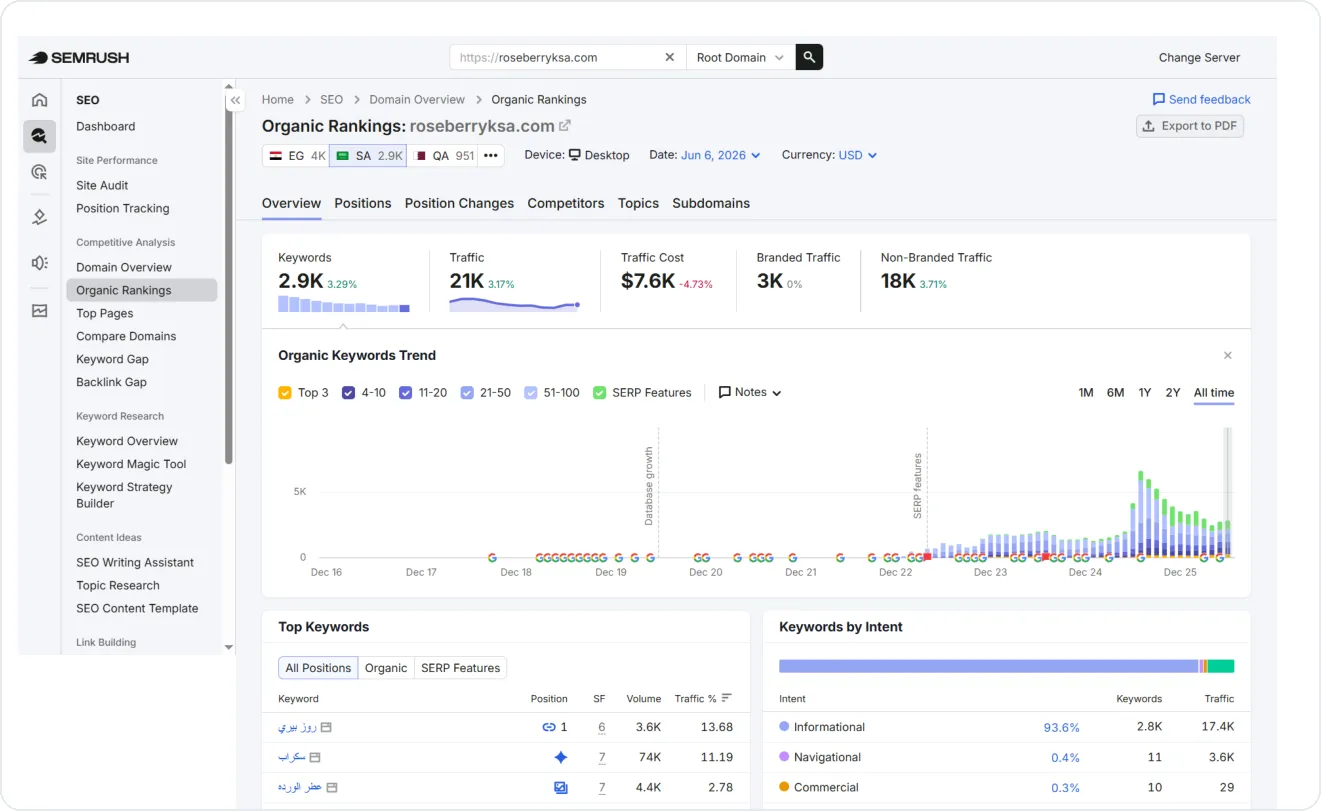
Every figure here is independently verifiable in Google Search Console, Moz and Semrush across an engagement that spanned 16 months — from roughly 25 impressions a day at the start to the following.
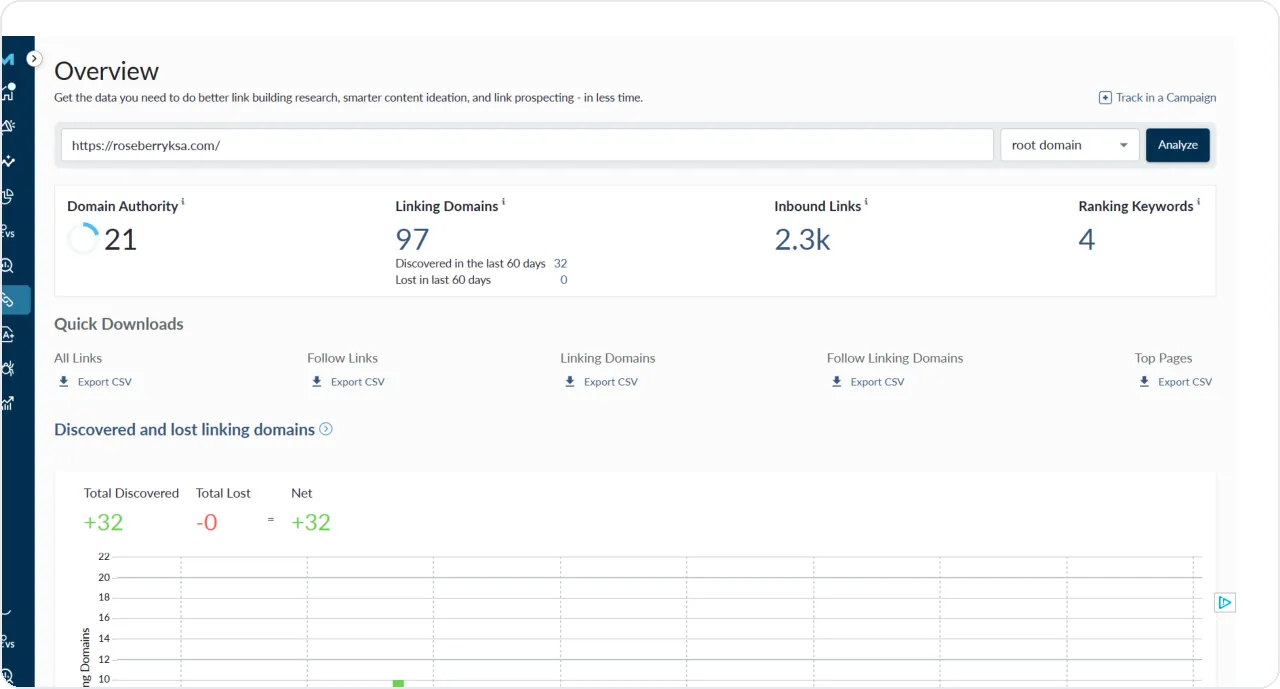
On the trust and off-page axis, the store reached 97 linking domains — with 32 gained and 0 lost in the last 60 days. That is clean growth with no erosion, which is a healthier backlink signal than the absolute number alone: a profile that is still acquiring quality domains while losing none is a profile Google increasingly trusts.
Discover and brand momentum
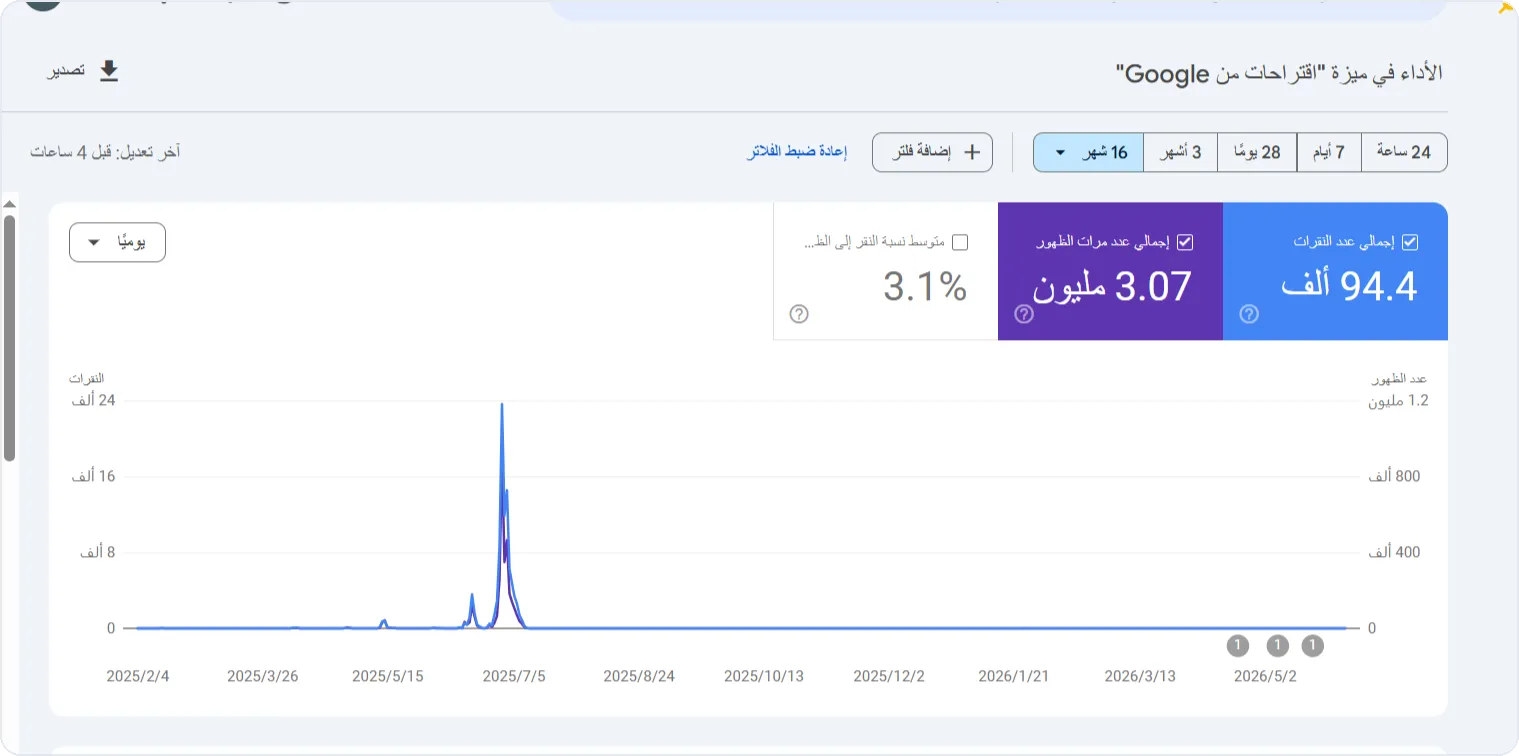
The impact reached beyond classic Google Search into Google Discover, where the store logged 3.07M impressions and 94.4K clicks — a channel that rewards visually strong, high-quality beauty content and proves the content architecture served more than search alone. And the momentum is recent, not historical:
At the brand level, the term ‘روز بيري’ now drives roughly 487 clicks per 28 days, sitting alongside high-intent informational beauty queries — evidence that demand for the brand itself has begun to form. The major Saudi stores build that demand through creator partnerships; here the structure and the content built it organically.
Why it worked: transferable lessons
What happened with Roseberry was not luck and not a secret recipe — it was a set of principles any beauty store owner, or any owner of a competitive store, can apply. You can see the same sequence recur across other case studies.
First: the technical foundation removes the ceiling on growth. As long as Google cannot crawl, understand and trust your pages, the best content and the strongest links stay inert. The 17-point technical fix is what freed everything that followed — without it, nothing would have compounded.
Second: build for how the buyer searches, not for what you wish they searched. In beauty, category, ingredient and problem come before brand. Category pages are the highest organic lever, and every page needs a single keyword job to avoid cannibalisation.
Third: Arabic is not a translation exercise. Gulf dialect, spelling variants, and country-targeted hreflang (ar-SA) separate targeting that gets seen from targeting that stays invisible. This is a systematic commitment, not a detail.
Fourth: report only what the client can verify. Every number in this case is sitting in Roseberry’s own Search Console, Moz and Semrush. That standard — proof you can check, not promises — is what makes the strategy worth trusting and worth repeating.
Questions about this case
How long does SEO take to show results for a beauty store on Salla?
Technical and indexation fixes can bring dozens of pages back into Google within days of a re-crawl, but topical authority and competitive ranking compound over time. With Roseberry the curve climbed across 16 months — from ~25 impressions a day to 51.5M impressions. The technical foundation removes the ceiling; content and links then push you up month after month.
Is keyword research translated from English enough for the Saudi market?
No. A Gulf shopper searches in colloquial Gulf Arabic — not formal Arabic and not Egyptian dialect — and Google treats Arabic spelling variants (hamza and alif forms) as separate queries. Literally translating an English keyword list produces targets with zero search volume. The fix is original, dialect-aware keyword research from a blank page, with every spelling variant mapped and addressed.
Why are category pages more important than product pages in beauty e-commerce?
Because a beauty buyer searches by category, ingredient and problem (moisturiser, vitamin C serum, pigmentation treatment) before they know a specific product. Category pages capture the high-volume head and the fat middle of demand, and they typically rank better and pull more traffic than individual product pages.
What is the single biggest technical mistake in beauty stores on hosted platforms?
Index bloat from faceted navigation: filter combinations (colour, type, skin, price) multiply into thousands of thin, near-duplicate URLs that burn crawl budget and dilute ranking signals. It is managed with correct canonicals, selective noindex, and blocking filter parameters in robots.txt.
Were these results built on ad spend?
No. Every figure is fully organic, taken from Google Search Console and verified through Moz and Semrush across 16 months. The estimated traffic value (about $7.6K) represents what it would cost to buy the same traffic through ads — it is the return on the organic foundation that was built, not a paid campaign.
More case studies
Ready to rank #1 on Google?
Get a free consultation and a custom growth plan for your project within 24 hours.