Built topical authority from scratch — 61K→1.2M impressions and 700→14K clicks in six months with content hubs and schema.
Real screenshots from the tools
Actual data from the client account — nothing dressed up.
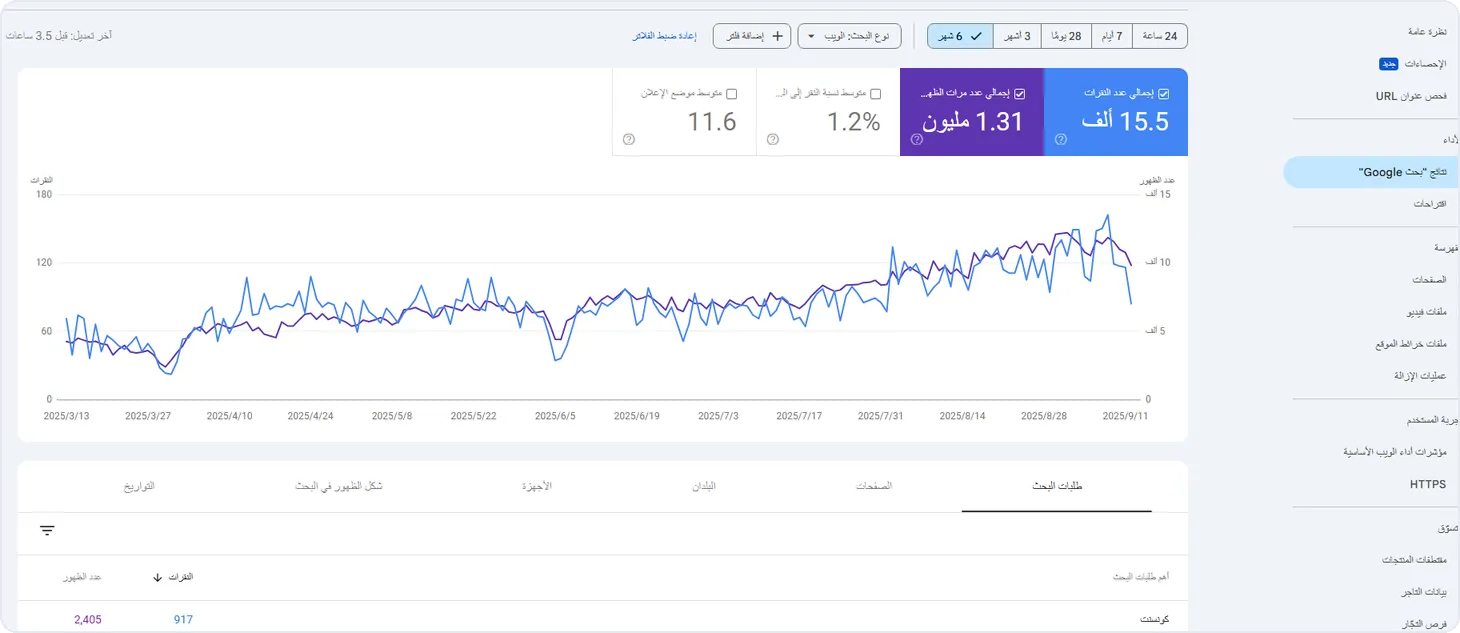
The starting point: a brand Google could not vouch for
Picture a furniture and home brand in Saudi Arabia with everything a business needs except visibility. The products are real, the showroom photography is beautiful, the catalogue is broad enough to furnish an entire home. And yet when you open Google Search Console, the numbers are almost embarrassing in their smallness: 61,000 impressions across a whole reporting window, and 700 clicks to show for it. Seven hundred. In a market where a single trending bedroom query can return tens of thousands of searches a month, Conscent was, for practical purposes, invisible.
This is the situation that quietly drains a founder. You are not failing at the thing you are good at — the product, the merchandising, the customer experience are all there. You are failing at the thing you were never trained to see: whether Google considers your website a credible answer to anything at all. And the honest, uncomfortable diagnosis was that it did not. Conscent had no topical authority. Google had no reason to believe this domain knew anything in particular about sofas, mattresses, dining sets, or how to furnish a Saudi home. To the algorithm, it was just another store hoping to be found.
The stakes were not abstract. Furniture is a high-consideration, high-ticket purchase. Buyers spend weeks researching — comparing materials, measuring rooms, deliberating over style — and almost all of that research begins in search. A brand absent from that research is absent from the only conversation that matters before the sale. Every riyal spent on inventory, photography and fulfilment was working against a ceiling: nobody was arriving to see it.
The brief, then, was not a tune-up. It was to build authority where none existed — to make Google trust a brand it had never had reason to trust, in a market where the established players had a head start measured in years.
The diagnosis: what the four-layer audit revealed
Before a single brief was written, the engagement began the way every serious one does — with a diagnosis. The instrument was a four-layer audit: crawl and index, performance, structure, then trust and off-page. Each layer answers a different question, and on a from-scratch authority build each one matters, because you cannot build credibility on a foundation that leaks.
Layer one — crawl and index
The first question is brutally simple: can Google find, crawl and index the pages that should rank, and is it wasting effort on pages that should not? The audit worked through robots.txt, the XML sitemap, canonical tags, hreflang, the custom 404 behaviour and clean URL resolution. For a furniture store this layer is rarely innocent — catalogue platforms tend to generate parameter-driven and faceted URLs that multiply into thin, near-duplicate variants and bleed crawl budget away from the pages that earn revenue. The goal here was a sitemap that reflected only high-priority, indexable pages, canonicals that consolidated duplicates honestly, and a crawl path that pointed Google at what mattered rather than at noise.
Layer two — performance
The second layer measured how the site actually feels on a real phone on a real Saudi network: Core Web Vitals, image formats (the move to WebP and AVIF), compression, minification and mobile usability. Furniture sites are image-heavy by nature — that is the product — which makes them prone to oversized hero banners and unoptimised galleries that push Largest Contentful Paint well past the threshold. Targets are unforgiving in 2026: LCP < 2.5s, INP < 200ms, CLS < 0.1. A research-stage buyer on mobile who waits four seconds for a guide to load simply leaves, and Google reads that abandonment.
Layer three — structure
The third layer examined how legible the site was to machines and people alike: Schema / JSON-LD coverage, Open Graph and Twitter card metadata, internal linking and readability. This is the layer that mattered most for the authority mission, because structure is where topical authority is either expressed or squandered. A pile of disconnected pages — no schema telling Google what they mean, no internal links showing how they relate — reads to the algorithm as a pile of disconnected pages. The audit found exactly that: content potential with no architecture to organise it into expertise.
Layer four — trust and off-page
The final layer assessed credibility from the outside in: DMARC and domain hygiene, backlink quality, referring domains and social signals. Here the diagnosis was the core problem stated plainly. The brand had almost no off-page authority — few quality referring domains, little earned coverage. In a competitive category, that absence is precisely why newly published content, however good, would sit unseen. Trust is the currency that lets content rank, and Conscent had not yet earned any.
The strategy: the thesis, and what was deliberately not done
The diagnosis pointed to a single thesis: Conscent did not have a traffic problem, it had an authority problem — and authority in a research-driven category is built with structured content, not bought with a bigger ad budget. Every strategic decision flowed from that thesis.
The first and most consequential trade-off was where to invest the early effort. The intuitive move for a store is to optimise product and category pages and chase transactional keywords. That was deliberately not the priority at the outset. The reason is how furniture buyers actually search. They do not begin by typing a product name; they begin with rooms, materials, styles and problems — how to arrange a small living room, what mattress firmness suits back pain, linen versus velvet for a family sofa. Those research queries are where the demand lives, and they are where authority is earned. So the strategy front-loaded content hubs and cluster pages that answered the research questions, and then engineered those clusters to funnel their hard-won authority into the e-commerce SEO category and product pages that convert.
The second decision was sequence. Authority cannot be assembled in any order — it has dependencies. The framework that governed the work runs deliberately: search intent matching, then technical SEO, then topical authority through content hubs and clusters, then content that ranks, then Digital PR, then continuous refresh — all measured in Google Search Console and GA4. Intent matching came first because building clusters around the wrong queries produces beautifully structured content that nobody searches for. Technical SEO came next because, as the audit showed, content published onto a flawed foundation is wasted. Only then did the content build begin.
The third decision was what not to chase. There was no attempt to manufacture authority with low-quality link schemes, no thin programmatic pages spun up to inflate page counts, and no translation of an English keyword list into Arabic — a tempting shortcut that produces zero-volume targets because Gulf buyers search in their own phrasing, and Google treats Arabic spelling variants as distinct queries. Restraint was as much a part of the strategy as action. The plan was to build fewer, deeper, genuinely useful pages that earned trust honestly, and to let Digital PR — not link buying — supply the off-page credibility.
The execution playbook
With the thesis set, execution followed the framework step by step. This is the sequence, mapped to each layer of the work.
1. Search intent matching
The first deliverable was not an article but a map. Every target query was classified by intent — informational, commercial, navigational, transactional — and clustered into the themes a furniture buyer actually moves through: rooms (living room, bedroom, dining, majlis), materials, styles, sizing and care. Critically, the keyword research was native to the Saudi market rather than translated, accounting for local phrasing and Arabic spelling variants so the targets had real search volume behind them. This map became the blueprint for everything that followed.
2. Technical SEO
Next, the foundation from the audit was repaired. Crawl waste was contained with disciplined robots.txt rules and honest canonicals; the XML sitemap was rebuilt to surface only priority indexable pages; hreflang and URL resolution were cleaned up; and the technical SEO performance work brought images to WebP and AVIF, applied compression and minification, and tightened Core Web Vitals on mobile. The principle: make the site fast, crawlable and perfectly indexed before asking Google to evaluate new content.
3. Topical authority — hubs and cluster pages
This was the heart of the engagement. Each theme from the intent map became a content hub — a comprehensive pillar page — supported by a cluster of focused articles answering the specific questions inside that theme. The hubs and clusters were bound together with deliberate internal linking, so that authority flowed inward to the pillars and onward to the commercial pages. This is the architecture that converts a pile of pages into demonstrable expertise: Google sees a domain that covers a subject in depth, with structure, and begins to treat it as a credible source on that subject.
4. Content that ranks
Every cluster page started from a content brief — a structured plan covering the target query, the searcher’s real question, the angle, the supporting subtopics and the internal links — so that each piece of content writing was engineered to rank, not just to fill a page. The content was paired with clean, valid Schema / JSON-LD: Article markup on guides, FAQPage on question-led sections, and HowTo on the step-by-step styling and care content. Open Graph and Twitter cards made every page shareable. Alongside the structured data, E-E-A-T signals were built in — clear authorship, transparent organisation information, and the trust markers that tell Google a real, accountable business stands behind the words.
5. Digital PR
With a foundation of credible content in place, Digital PR went to work on the trust layer the audit had flagged as the core weakness. Earned coverage and quality referring domains supplied the off-page authority that lets newly published content actually rank rather than sit unseen — the legitimate, durable alternative to link schemes. For a brand starting from near-zero authority, this is frequently the fastest honest way to break through, and it is the natural complement to a serious link building approach.
6. Continuous refresh, measured
Finally, the work was treated as living infrastructure rather than a one-time push. Performance was tracked continuously in Google Search Console and GA4, content was refreshed as queries and the SERP evolved, and the cluster map was extended into the themes that proved most valuable. Every decision after launch was made against real data from the client’s own dashboards.
The verified outcome
The result of the six-month engagement, read directly from Google Search Console, was the kind of step-change that only a real authority build produces. The brand that had registered 61,000 impressions and 700 clicks became a destination that Google surfaced 1.2 million times, drawing 14,000 clicks in the process.
These are not modelled or estimated numbers — they are read straight from the client’s own Google Search Console, verifiable line by line. The shape of the growth tells the real story. Impressions multiplying roughly twentyfold means Google moved from rarely showing the brand at all to surfacing it across a vast range of research queries — the direct signature of topical authority taking hold. Clicks growing in step means the impressions were earned on relevant queries, with content and structure compelling enough to win the visit. Authority, built deliberately, compounded into reach; reach, earned honestly, converted into traffic.
You can see the same pattern across other engagements in the case studies — different markets, different platforms, the same disciplined sequence producing compounding organic growth.
Why it worked: transferable lessons
The most useful thing a case study can leave behind is not the result but the reasons — the principles a business owner can apply to their own site. Four stand out.
1. Authority is a structure you build, not a budget you spend. Conscent’s transformation came from organising content into hubs and clusters that Google could read as expertise, not from a bigger ad spend. Any business in a research-driven category can apply this: stop thinking in scattered blog posts and start thinking in subject areas, each anchored by a pillar and supported by a cluster, all linked deliberately. Depth and structure are what earn trust.
2. Win the research phase to win the sale. In high-consideration categories — furniture, but equally jewellery, real estate, B2B services — the purchase decision is made during research, and research happens in search. The brand that answers the questions buyers ask before they are ready to buy becomes the default choice when they are. Optimising only your transactional pages is fishing at the very end of a long river; the demand is upstream.
3. Fix the foundation before you scale the content. The four-layer audit was not bureaucracy — it was the guarantee that every later effort would pay off. Publishing onto a leaky technical base means crawl waste hides your work, slow pages bury it, and missing schema stops Google from understanding it. Whatever your content ambitions, make the site fast, crawlable, perfectly indexed and clearly structured first.
4. Earn trust honestly, and let it compound. Digital PR supplied the off-page credibility that let new content rank, without the fragility of link schemes. Authority earned this way does not evaporate with the next algorithm update — it accumulates. The growth curve from 61K to 1.2M impressions is the proof: this is what happens when technical foundations, structured content and genuine trust signals reinforce one another over time, measured every step in Google Search Console and GA4.
The deeper lesson is the most transferable of all. Conscent was never short on quality — it was short on a reason for Google to trust it. Build that reason deliberately, in the right sequence, and the visibility follows. That is the discipline behind every result here, and it is exactly the work that turns a brand Google has never noticed into one it cannot ignore.
Questions about this case
How long does it take to build topical authority for a furniture site from scratch?
Authority is cumulative, so it compounds rather than spikes. For Conscent the curve climbed over a six-month engagement — from 61K to 1.2M impressions in Google Search Console — as the technical foundation, content hubs and Digital PR reinforced one another. The first technical and indexation wins surface within weeks; the authority that drives the big impression growth builds month over month.
Why focus on content clusters instead of just optimising product pages for furniture?
Furniture buyers research by room, material, style and problem long before they choose a specific product — they search how to style a small living room, linen versus velvet sofas, mattress firmness. Cluster pages capture that high-volume research demand, build subject-matter depth Google can trust, and then funnel that authority to the product and category pages that convert.
Does schema markup actually help a furniture or home brand rank?
Schema does not move rankings on its own, but Article, FAQ and HowTo structured data tells Google precisely what each page means, makes the brand eligible for rich results, and helps both classic search and AI answers cite the content accurately. On a from-scratch authority build it is part of how you earn trust quickly.
Is Digital PR worth it for a home and furniture brand in Saudi Arabia?
Yes — earned coverage and quality referring domains are among the strongest trust signals in a competitive market. For a brand with no existing authority, Digital PR is often the fastest legitimate way to acquire the off-page credibility that lets newly published content actually rank rather than sit unseen.
How do you prove SEO results for a project like this?
Every number is read straight from Google Search Console and GA4 — the same dashboards the client owns and can open themselves. The verified figures for Conscent are impression growth from 61K to 1.2M and click growth from 700 to 14K over the engagement. Nothing reported here is estimated or modelled.
More case studies
Ready to rank #1 on Google?
Get a free consultation and a custom growth plan for your project within 24 hours.