Recovered a store crushed by technical issues — diagnosed, rebuilt the content plan, and reached #1 in KSA in 166 days.
Real screenshots from the tools
Actual data from the client account — nothing dressed up.
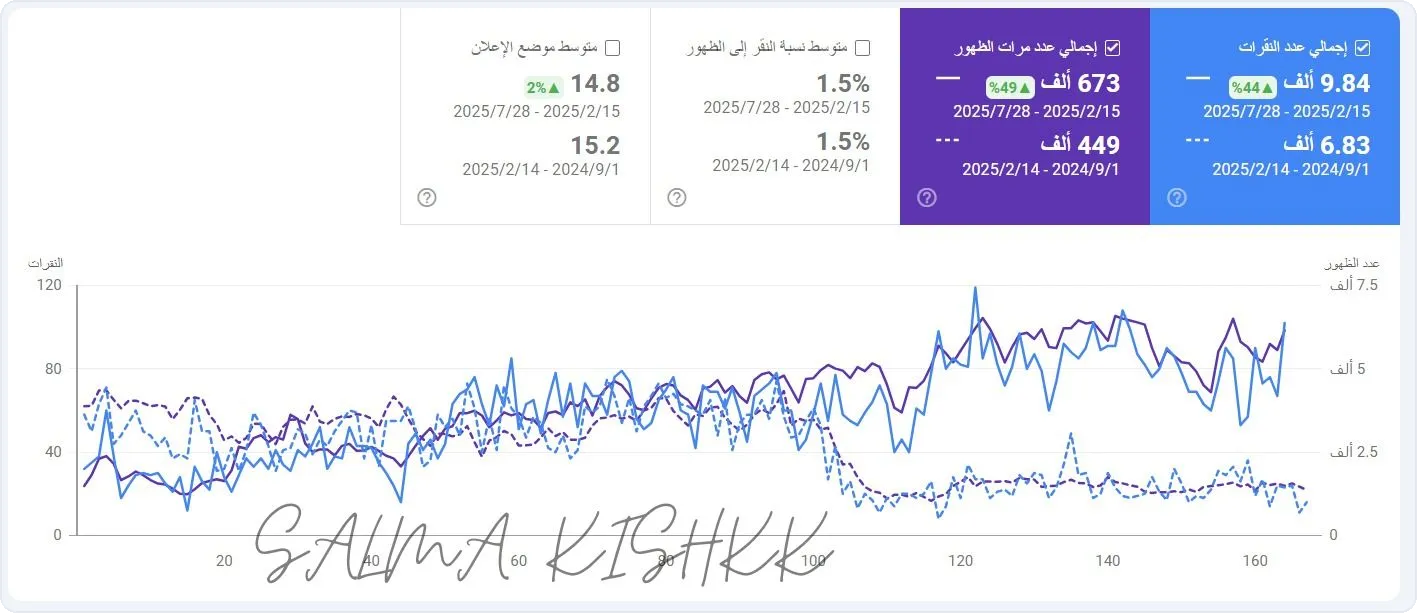
The starting point: a store sliding out of search
Picture the moment a store owner opens Google Search Console and watches a line that used to climb now bend downward — week after week, fewer impressions, fewer clicks, and the products that once paid the bills drifting off the first page. The catalogue is real. The customers who do arrive still convert. Nothing about the business has changed except the one thing that quietly decides everything: Google’s ability to find, understand and trust the site.
That was the reality for this niche store in Saudi Arabia. This was not a slow ramp from zero; it was a decline — a site that had earned visibility and was now losing it. A traffic drop of that kind is a different emotional experience from a launch. It feels like something is being taken away, and the owner usually cannot see why, because the symptoms (falling rankings, vanishing pages) sit far downstream from the causes (a misfiring robots.txt rule, a canonical pointing the wrong way, a render-blocking script). The temptation in that moment is to publish more — more products, more blog posts — in the hope that volume reverses the slide. It almost never does, because the problem is not a shortage of content. The problem is that the foundation the content rests on has cracked.
In a market as competitive as Saudi e-commerce, where buyers research on mobile and rivals are professionalising their own SEO, a sliding site does not plateau — it gets overtaken. Every position lost is a position a competitor gains. So the engagement did not begin with a content calendar or a link campaign. It began the only way a recovery responsibly can: with a diagnosis.
The diagnosis: what the four-layer audit revealed
Before a single word was rewritten or a single link pursued, the site was put through a structured four-layer audit — crawl and index, then performance, then structure, then trust. The discipline of the four layers is that it stops you from guessing. A traffic collapse has a root cause; the audit’s job is to surface it instead of treating symptoms. Here is what each layer exposed.
Layer 1 — Crawl & index
This is where the heaviest damage lived, and it is where most unexplained drops originate. The investigation walked through the crawl-and-index fundamentals in order: robots.txt directives, the XML sitemap, canonical tags, hreflang, the custom 404 behaviour and how URLs resolved. The pattern that emerges in a collapsed store is almost always the same — crawl budget leaking into low-value URLs while the money pages are crawled rarely or excluded outright, and indexation signals (canonicals, noindex, redirects) quietly contradicting each other so that Google hides pages the owner desperately wants ranked. When the pages that should rank are not properly indexed, no amount of content or links can save them; they are simply not in the race.
Layer 2 — Performance
The second layer measured how the site actually felt on a real phone, because the overwhelming majority of Saudi traffic is mobile. Performance was assessed against Core Web Vitals — Largest Contentful Paint, Interaction to Next Paint and Cumulative Layout Shift — alongside image delivery (whether modern WebP/AVIF formats were used), compression, minification and mobile usability. A product-heavy store is a textbook candidate for Core Web Vitals failure: oversized hero and product imagery pushes LCP past the threshold, render-blocking scripts delay interactivity, and unsized media causes layout shift. In 2026 Google judges these together as one composite experience signal, so a single weak metric drags the whole score down on the mid-range devices real buyers use.
Layer 3 — Structure
The third layer examined whether Google could understand the site, not just reach it. That meant auditing the structured data (Schema/JSON-LD), Open Graph and Twitter card markup, the internal-linking architecture and on-page readability. The recurring failure here is twofold: structured data that is thin or absent — no rich Product markup, no Organization node, no FAQ — which forfeits rich results and confuses entity understanding for AI systems; and an internal-link structure that fails to pass authority from the homepage down through categories to the pages that need to rank. A site can be crawlable and fast and still underperform because Google cannot tell which pages matter or how they relate.
Layer 4 — Trust & off-page
The final layer looked at the signals that tell Google this is a legitimate, trustworthy business: email authentication via DMARC, the quality of the backlink profile, the health of referring domains, and social signals. In a recovery, the off-page picture matters less for chasing new links than for ruling out trust problems that could be amplifying an algorithmic demotion.
The strategy: the thesis and the trade-offs
The audit produced a prioritised list of problems. But a list is not a strategy. The strategy needed a thesis, and the thesis here was deliberate: in a recovery, you must first remove what is suppressing the site, then rebuild on how buyers actually search — and the technical foundation must come before the content, never alongside it.
Why technical first, content second
It is tempting in a recovery to do everything at once — fix the crawl issues while pumping out new articles, hoping both levers pull together. That is a mistake. New content published onto a broken foundation inherits the same suppression: it may not get crawled, may not get indexed, and may worsen the crawl waste that caused the problem. So the sequence was non-negotiable. First the technical SEO recovery — restore clean crawling, indexation, performance and structure. Only once Google could reliably reach, render, understand and trust the site did content rebuilding begin in earnest. This is the difference between building on cleared ground and building on rubble.
Rebuilding the content plan from intent, not inventory
The second strategic decision was to throw out whatever ad-hoc content logic had existed and rebuild the plan from scratch around search intent. Rather than mirroring the product catalogue, the plan started from how Saudi buyers actually phrase their searches — the problems, categories and questions they type before they ever know a specific product name. Commercial and transactional intent was mapped to category and product pages; informational intent was mapped to articles and guides that feed the funnel toward purchase. This is the foundation of any durable e-commerce SEO program: every page earns a clear job, and no two pages compete for the same query.
What was deliberately not done
A strong strategy is defined as much by its restraint. Deliberately, the recovery did not chase an aggressive early link campaign before the site had earned links with real content and structure. It did not publish high volume for its own sake while the technical layer was still compromised. And it did not treat appearing in Google’s AI Overview as a separate, exotic objective requiring special tactics — because Google’s own position is that ranking in AI answers is still SEO, gated by the same fundamentals. The trade-off weighed throughout was speed against durability, and durability won. A recovery that comes back fast on a shaky foundation simply collapses again at the next core update.
The execution playbook
With the thesis set, execution followed the documented process end to end: search-intent matching, then technical SEO, then topical authority, then content that ranks, then digital PR, then continuous refresh — every stage measured in Google Search Console and GA4.
1) Search-intent matching
The rebuild began on a blank page with genuine keyword research grounded in how Saudi buyers search — not a translated English keyword list, which produces zero-volume targeting. Each intent was sorted: transactional and commercial queries assigned to category and product pages, informational queries assigned to articles. Every page was given a single, clear keyword job to prevent the cannibalisation that leaves Google unable to confidently rank either of two pages chasing the same term.
2) Technical SEO — clearing the collapse
This was the lever that freed everything after it, executed straight off the four-layer audit:
- Crawl and index: corrected the
robots.txtdirectives, rebuilt an accurate XML sitemap reflecting only high-priority indexable pages, fixed the canonical,noindexand redirect conflicts that were hiding pages, repaired URL resolution and the custom 404 behaviour, and tightened hreflang so Saudi users were targeted correctly. - Performance: addressed Core Web Vitals on real mobile hardware — converting images to modern WebP/AVIF formats, enabling compression and minification, preloading critical assets and deferring non-critical scripts, and resolving the mobile usability issues that hurt interactivity and layout stability.
- Structure: implemented clean, valid Schema/JSON-LD for the relevant types, set proper Open Graph and Twitter card markup, and re-engineered internal linking so authority flowed from the homepage through categories to the pages that needed to rank.
3) Topical authority — hubs and clusters
Once the foundation was sound, the content architecture was rebuilt as topical hubs with supporting cluster pages. Each hub anchored a core topic and linked out to its cluster of related articles and product or category pages, with the clusters linking back to the hub. This hub-and-cluster structure is how you demonstrate genuine topical depth to Google and distribute authority across a subject area, rather than leaving pages stranded and isolated.
4) Content that ranks
On top of that architecture, the content itself was written to rank — matching the mapped intent, answering the buyer’s real question, and structured for both human readability and machine comprehension. Commercial pages were built to convert search intent into purchase; informational guides were built to capture upper-funnel research and feed it downward. Strong content writing here was the difference between pages that merely exist and pages Google chooses to surface — including, ultimately, inside AI Overviews.
5) Digital PR
With the site finally worthy of the links it sought, digital PR and link building followed — earning relevant, quality references and healthy referring domains rather than chasing volume. Sequencing this stage last was deliberate: links pointed at a recovered, well-structured site compound; links pointed at a broken one are wasted.
6) Continuous refresh
A recovery is not a project you finish and forget — a platform update or a product import can quietly reintroduce the very problems that caused the original collapse. Measurement continued in Google Search Console and GA4 to catch regressions early and to keep refreshing content so the gains compounded instead of decaying.
The verified outcome
The result is stated exactly as it stands, with no embellishment. Over 166 days of focused work — under six months — the store moved from a technical collapse to the top of its market.
The headline is straightforward: the store reached #1 in Saudi Arabia for most of its products and articles, and its results were featured in Google’s AI Overview — the generative answers that now sit above classic results for a large share of queries. That AI Overview presence is not a separate achievement bolted on at the end; it is the natural consequence of the recovery. By making the site fast, crawlable, properly indexed, well-structured and genuinely useful, the work made it eligible for exactly the citations Google’s AI systems award to trustworthy, well-answered pages. The fundamentals that won classic rankings won the AI surface too — precisely as Google’s own guidance predicts.
Why it worked: transferable lessons
What happened here was not luck, and it was not a secret tactic. It was a set of principles any store owner facing a traffic drop can apply. You can see the same sequence repeat across other case studies — the order is the point.
First: a recovery is a diagnosis problem before it is a content problem. When traffic falls, the instinct is to make more. But a drop has a root cause, and until you find it with a structured audit, more content just feeds the same broken machine. The four-layer audit — crawl and index, performance, structure, trust — is how you replace guessing with knowing.
Second: fix the foundation before you build on it. The technical layer was cleared first, on purpose, because content and links can only perform as well as the foundation allows. Publishing onto a compromised site wastes the work and can deepen the damage. Clear ground first; build second.
Third: rebuild content on how buyers actually search, not on your inventory. Throwing out the old logic and starting the content plan from intent — mapping commercial queries to commercial pages and informational queries to guides, each page with one clear job — is what made the new content rank instead of cannibalise.
Fourth: earn your links before you chase them. Digital PR was sequenced last, after the site had become worthy of references through real structure and content. Links pointed at a recovered site compound; links pointed at a broken one are wasted budget.
Fifth: AI visibility is earned through fundamentals, not tricks. The AI Overview citations came from the same work that won classic rankings — speed, crawlability, accurate structured data and genuinely useful answers. There was no separate AI tactic, because there did not need to be.
Sixth: measure relentlessly and never stop. Everything was tracked in Google Search Console and GA4, and the continuous-refresh stage exists because a single platform update can undo months of recovery. Growth that is not measured cannot be defended — or repeated.
If your store has slipped out of the rankings it once held, the distance between you and a recovery curve like this one is not a mystery and it is not luck. It is a correct diagnosis, a cleared technical foundation, a content plan rebuilt on how your buyers actually search, and the patience to run the sequence in order. That is exactly what turned a collapsed Saudi store into the market leader of its niche in 166 days.
Questions about this case
Can a store that lost most of its traffic actually recover to #1?
Yes — but only if you treat it as a diagnosis problem, not a content problem. A traffic drop almost always has a root cause: a botched migration, an indexation mistake, crawl waste, an algorithm hit, or accumulated technical debt. In this engagement the collapse was reversed by finding and fixing those root causes first, then rebuilding an intent-based content plan on top of a clean foundation. The store reached #1 in Saudi Arabia for most of its products and articles in under six months — 166 days of focused work.
How long does a recovery like this take?
Some wins are near-instant: correcting a noindex rule or a broken canonical can return pages within days of a re-crawl. But durable, market-leading rankings compound over weeks and months as Google re-evaluates a recovered site's quality, structure and authority. Here the full arc — from technical collapse to #1 across most products and articles — took 166 days. Recovery is faster than building from zero because the brand, the products and some history already exist; the job is to remove what is suppressing them.
Why fix the technical issues before writing new content?
Because content can only perform as well as the foundation underneath it allows. If Google cannot crawl, render, index and trust your pages, even excellent articles stay invisible. Publishing fresh content onto a broken foundation wastes the work — and can deepen crawl waste. The correct sequence is to clear the technical debt first, so every piece of content you publish afterward is eligible to rank from day one.
What does it take to appear in Google's AI Overview?
Google's own 2026 guidance is blunt: ranking in AI Overviews is still SEO. There is no separate AI layer and no magic schema. Eligibility comes from the same fundamentals — fast, crawlable pages, accurate structured data, genuinely useful content that matches search intent, and clear, well-structured answers. In this engagement the store earned AI Overview citations as a direct consequence of the technical recovery and the intent-based content rebuild, not as a separate tactic.
Is this approach specific to one platform or industry?
The framework is platform-agnostic. The four-layer audit — crawl and index, performance, structure, trust — applies to any e-commerce stack, and the process sequence from search intent to continuous refresh works whether you sell skincare, hardware or software. What changes per project is the diagnosis: which specific issues are suppressing this particular site, and which intents its particular buyers search with.
More case studies
Ready to rank #1 on Google?
Get a free consultation and a custom growth plan for your project within 24 hours.