Content-hub strategy lifting a health brand’s organic visibility in the Egyptian market.
Real screenshots from the tools
Actual data from the client account — nothing dressed up.
The starting point: a trust-sensitive brand in a crowded market
Picture a health and herbal brand in Egypt with a real product, a genuine point of view about natural wellness, and a market of millions who search for exactly what it sells. And yet, when you open Google Search Console, the site is barely registering — a young domain in a niche where the first page is already occupied by established pharmacies, sprawling marketplaces and content publishers who have been compounding their authority for years. Oxford was not failing because the product was weak. It was struggling because, in this particular corner of search, being good is not enough to be seen.
This is the situation that quietly tests a founder’s nerve. You are operating in health — and health, in Google’s vocabulary, is a Your Money or Your Life topic. That label is not bureaucratic; it is the single most consequential fact about the engagement. For queries that can affect a person’s wellbeing, finances or safety, Google applies the strictest possible scrutiny under its E-E-A-T framework — Experience, Expertise, Authoritativeness and Trustworthiness. A herbal brand does not get the benefit of the doubt the way a lifestyle blog might. It has to demonstrate that it knows what it is talking about, that a real and accountable organisation stands behind every claim, and that the wider web vouches for it. Absent that demonstration, even accurate content sits unseen.
The stakes were concrete. Health and herbal purchases are high-consideration and high-trust by nature. Buyers research a condition, an ingredient, a benefit or a safety concern long before they reach for a product — and almost all of that research begins in search. A brand absent from that research is absent from the only conversation that matters before the sale. Every pound spent on formulation, packaging and fulfilment was working against a ceiling: the people the brand could help were finding their answers on competitors’ pages.
The brief, then, was not a cosmetic tune-up. It was to earn visibility in a market that grants it grudgingly — to make Google trust a health brand it had no prior reason to trust, against incumbents with a head start measured in years.
The diagnosis: what the four-layer audit revealed
Before a single hub was outlined, the engagement began the way every serious one does — with a diagnosis. The instrument was a four-layer audit: crawl and index, performance, structure, then trust and off-page. Each layer answers a different question, and in a trust-sensitive niche each one carries extra weight, because you cannot build credibility on a foundation that leaks.
Layer one — crawl and index
The first question is brutally simple: can Google find, crawl and index the pages that should rank, and is it wasting effort on pages that should not? The audit worked through robots.txt, the XML sitemap, canonical tags, hreflang, the custom 404 behaviour and clean URL resolution. For a young site, the most common silent failure is not penalty but absence — pages that have simply never been discovered, an incomplete sitemap, or canonical and noindex signals that quietly hide content from search. The goal here was unambiguous: a sitemap that surfaces only high-priority, indexable pages, canonicals that consolidate honestly, clean URL resolution, and a crawl path that points Google at what matters rather than at noise.
Layer two — performance
The second layer measured how the site actually feels on a real phone on a real Egyptian network: Core Web Vitals, image formats (the move to WebP and AVIF), compression, minification and mobile usability. Egypt is a mobile-first market with widely varying connection quality, which makes performance a ranking and a revenue issue at once. The 2026 targets are unforgiving — LCP < 2.5s, INP < 200ms, CLS < 0.1 — and a research-stage health buyer who waits four seconds for a guide to load on a mid-range phone simply leaves. Google reads that abandonment as a signal.
Layer three — structure
The third layer examined how legible the site was to machines and people alike: Schema / JSON-LD coverage, Open Graph and Twitter card metadata, internal linking and readability. This is the layer that matters most for the authority mission, because structure is where topical authority is either expressed or squandered. A pile of disconnected pages — no schema telling Google what they mean, no internal links showing how they relate — reads to the algorithm as exactly that: a pile of disconnected pages. In a health niche, structured authorship and organisation data are not decoration; they are how a YMYL site signals the expertise and accountability Google is specifically looking for.
Layer four — trust and off-page
The final layer assessed credibility from the outside in: DMARC and domain hygiene, backlink quality, referring domains and social signals. Here the diagnosis was the core constraint stated plainly. As a younger brand in a contested niche, Oxford had limited off-page authority — few quality referring domains and a Domain Authority that did not yet match the company it would have to keep on the first page. In a YMYL category, that gap is precisely why otherwise excellent content can struggle to break through. Trust is the currency that lets health content rank, and it had not yet been fully earned.
The strategy: the thesis, and what was deliberately not done
The diagnosis pointed to a single thesis: Oxford did not have a traffic problem, it had a trust problem — and trust in a Your Money or Your Life category is built with depth and structure, not bought with a bigger ad budget. Every strategic decision flowed from that thesis.
The first and most consequential trade-off was where to invest the early effort. The intuitive move for a brand with products to sell is to optimise product pages and chase transactional keywords. That was deliberately not the priority at the outset. The reason is how health buyers actually search. They do not begin by typing a product name; they begin with conditions, ingredients, benefits and safety questions — what a particular herb is good for, how to use it, whether it interacts with anything, what helps with a specific complaint. Those research queries are where the demand lives, and they are where a health brand earns the right to be trusted. So the strategy front-loaded content hubs built around proven query themes — themes validated against real search demand, not guessed — and engineered those hubs to funnel their hard-won authority toward the e-commerce SEO pages that convert.
The second decision was sequence. Authority cannot be assembled in any order — it has dependencies. The framework that governed the work runs deliberately: search intent matching, then technical SEO, then topical authority through content hubs and clusters, then content that ranks, then Digital PR, then continuous refresh — all measured in Google Search Console and GA4. Intent matching came first because building hubs around the wrong themes produces beautifully structured content that nobody searches for. Technical SEO came next because, as the audit showed, content published onto a flawed or undiscovered foundation is wasted. Only then did the content build begin.
The third decision was what not to chase. There was no attempt to manufacture authority with low-quality link schemes — especially dangerous in a YMYL niche, where Google’s trust scrutiny is highest and a spammy link profile can do real harm. There were no thin programmatic pages spun up to inflate page counts, and no machine-translated keyword list, which produces zero-volume targets because Egyptian buyers search in their own Arabic phrasing and Google treats spelling variants as distinct queries. Restraint was as much a part of the strategy as action. The plan was to build fewer, deeper, genuinely useful hubs that earned trust honestly — and then, once those hubs were proving their value in Search Console, to begin clean link building as the deliberate next lever to lift Domain Authority. Earned, editorial links, in the right order, never as a shortcut.
The execution playbook
With the thesis set, execution followed the framework step by step. This is the sequence, mapped to each layer of the work.
1. Search intent matching
The first deliverable was not an article but a map. Every target query was classified by intent — informational, commercial, navigational, transactional — and clustered into the themes a health and herbal buyer actually moves through: conditions and complaints, individual ingredients and herbs, benefits and use-cases, safety and dosage, and the product categories that sit at the end of that journey. Critically, the keyword research was native to the Egyptian market rather than translated, accounting for local phrasing and Arabic spelling variants so the proven query themes had real search volume behind them. This map became the blueprint for everything that followed.
2. Technical SEO
Next, the foundation from the audit was repaired. Discovery and indexation were prioritised — a rebuilt XML sitemap surfacing only priority indexable pages, honest canonicals, clean URL resolution, and the removal of any signal quietly hiding content from search. The technical SEO performance work brought images to WebP and AVIF, applied compression and minification, and tightened Core Web Vitals on mobile for real Egyptian network conditions. The principle: make the site fast, crawlable and perfectly indexed before asking Google to evaluate new content in a niche where it judges harshly.
3. Topical authority — hubs and cluster pages
This was the heart of the engagement. Each proven theme from the intent map became a content hub — a comprehensive pillar page — supported by a cluster of focused articles answering the specific questions inside that theme. The hubs and clusters were bound together with deliberate internal linking, so that authority flowed inward to the pillars and onward to the commercial pages. This is the architecture that converts a pile of pages into demonstrable expertise: Google sees a domain that covers a health subject in genuine depth, with structure, and begins to treat it as a credible source on that subject — the precondition for ranking anything in a YMYL niche.
4. Content that ranks
Every cluster page started from a content brief — a structured plan covering the target query, the searcher’s real question, the angle, the supporting subtopics and the internal links — so that each piece of content writing was engineered to rank, not just to fill a page. The content was paired with clean, valid Schema / JSON-LD: Article markup on guides, FAQPage on question-led sections, and HowTo on step-by-step usage content. Open Graph and Twitter cards made every page shareable. Most important for a health brand, E-E-A-T signals were built in deliberately — clear authorship, transparent organisation information, and the trust markers that tell Google a real, accountable business stands behind every wellness claim. In a Your Money or Your Life niche, this is not polish; it is eligibility.
5. Digital PR and clean link building
With a foundation of credible content in place and beginning to index, attention turned to the trust layer the audit had flagged as the core constraint. Digital PR and a disciplined link building approach were the recommended next lever — earned coverage and quality referring domains that supply the off-page authority a YMYL site needs to rank faster, and the legitimate, durable alternative to the link schemes that are especially hazardous in health. The explicit recommendation coming out of the engagement was to begin clean, quality-first link building to lift Domain Authority now that the content hubs were proving their value in Search Console.
6. Continuous refresh, measured
Finally, the work was treated as living infrastructure rather than a one-time push. Performance was tracked continuously in Google Search Console and GA4, content was refreshed as queries and the SERP evolved, and the hub map was extended into the themes that proved most valuable. Every decision after launch was made against real data from the client’s own dashboards — never a guess.
The verified outcome
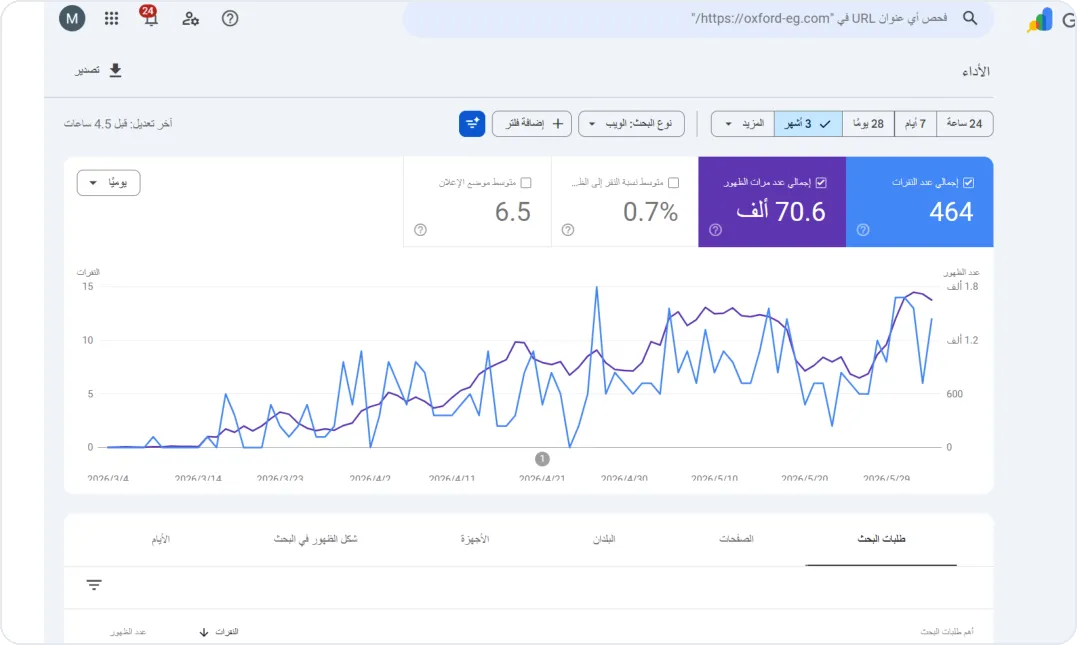
The result, read directly from Google Search Console, is the signature of a content-hub strategy taking hold in a hard market. The site has indexed and begun climbing: 70,600 impressions, 464 clicks, and an average position of 6.5 — and rising — as it gains steady traction in the Egyptian market.
These are not modelled or estimated numbers — they are read straight from the client’s own Google Search Console, verifiable line by line. The shape of the data is what matters most for a still-young health brand. An average position of 6.5 means the content is consistently landing on the first page for its themes — close to the cluster of results that actually earn clicks — rather than languishing on page two or beyond. In a Your Money or Your Life niche, where Google is slowest to trust a newer domain, reaching a first-page baseline is itself the hard-won proof that the E-E-A-T signals and topical depth are registering. The 70.6K impressions show that Google is now surfacing the brand across a meaningful range of research queries; the 464 clicks confirm those impressions are being earned on relevant terms, with content compelling enough to win the visit.
You can see the same disciplined sequence at work across other engagements in the case studies — different markets, different platforms, the same framework producing compounding organic growth.
Why it worked: transferable lessons
The most useful thing a case study can leave behind is not the result but the reasons — the principles a business owner can apply to their own site. Four stand out.
1. In a YMYL niche, trust is the product before the product. Oxford’s climb came from building content that demonstrated expertise, authorship and accountability — the E-E-A-T signals Google specifically demands of health sites — not from a bigger ad spend. Any business in a trust-sensitive category (health, finance, legal, safety) can apply this: assume Google will not give you the benefit of the doubt, and engineer the proof of credibility into every page. In these niches, eligibility to rank is something you earn structurally, not something you are granted.
2. Win the research phase to win the sale. Health buyers decide during research — about ingredients, benefits, safety — and research happens in search. The brand that answers the questions people ask before they are ready to buy becomes the default choice when they are. Optimising only your product pages is fishing at the very end of a long river; the demand, and the chance to build trust, is upstream. Content hubs around proven query themes are how you fish where the water is.
3. Fix the foundation, then build content, then earn links — in that order. The four-layer audit was not bureaucracy; it was the guarantee that every later effort would pay off. Publishing onto an undiscovered or slow foundation means good guides never index or get buried. Building links before the content exists wastes the trust they confer. Oxford’s sequence — technical foundation, then content hubs, then the recommendation to begin clean link building to lift Domain Authority — is the order that makes each stage compound the last rather than fight it.
4. Earn authority honestly, and let it compound. The deliberate choice to avoid link schemes and reach for clean, quality-first link building is not caution for its own sake — it is durability. Authority earned this way does not evaporate with the next core update; it accumulates. The climb to an average position of 6.5 with 70.6K impressions is the early proof: this is what happens when technical foundations, structured content and genuine trust signals reinforce one another, measured every step in Google Search Console and GA4.
The deeper lesson is the most transferable of all. Oxford was never short on quality — it was short on a reason for Google to trust it in the one niche where Google trusts slowest. Build that reason deliberately, in the right sequence, and the visibility follows. That is the discipline behind every result here, and it is exactly the work that turns a brand a crowded market overlooks into one it has to make room for.
Questions about this case
How hard is it to rank a health and herbal brand on Google in Egypt?
It is one of the harder niches, because health is a Your Money or Your Life topic — Google applies its strictest E-E-A-T scrutiny, and the Egyptian SERP is crowded with established pharmacies, marketplaces and content sites. That is exactly why the strategy here led with content hubs around proven query themes rather than scattered pages: depth and structure are how a newer brand earns the trust that lets it rank at all. The verified Search Console figures — 70.6K impressions, 464 clicks, average position 6.5 — show the approach is working as the site indexes and gains traction.
Why build content hubs instead of just optimising product pages for a herbal brand?
Health buyers research a condition, an ingredient or a benefit long before they choose a product — they search what a herb is good for, how to use it, whether it is safe. Content hubs and cluster pages capture that high-intent research demand, build the subject-matter depth Google needs to trust a health domain, and then funnel that authority toward the pages that convert. Optimising only product pages fishes at the very end of a long research journey.
What does an average position of 6.5 actually mean for a site this young?
Average position is the mean ranking across every query the site appears for in Google Search Console. A 6.5 average on a still-indexing health brand means the content is consistently landing on the first page for its themes — close to the cluster of results that earn real clicks — rather than languishing on page two or beyond. It is a healthy, climbing baseline that compounds as authority builds.
Is link building necessary, or can content alone carry a health brand?
Content earns the right to rank; links and referring domains often supply the trust that lets it rank faster in a competitive YMYL niche. For Oxford the recommendation was to begin clean, quality-first link building to lift Domain Authority — earned, editorial links rather than schemes — as the natural next lever once the content hubs were proving their value in Search Console.
How do you prove SEO results for a project like this?
Every number is read straight from Google Search Console and GA4 — the same dashboards the client owns and can open themselves. The verified figures for Oxford are 70.6K impressions, 464 clicks and an average position of 6.5, with indexing and traction climbing in the Egyptian market. Nothing reported here is estimated or modelled.
More case studies
Ready to rank #1 on Google?
Get a free consultation and a custom growth plan for your project within 24 hours.